Guide
Denim factory certifications explained:
GRS, RCS, BSCI and ISO
Retailers, marketplaces and customers increasingly ask brands for proof of how their jeans are made. A factory's certificates are usually the first thing they ask for.
This guide explains GRS, RCS, amfori BSCI, ISO 9001 and ISO 14001: what each one covers, who issues it, and what it does and does not prove.
It also shows how to check a certificate, and ends with a checklist of what to request from any factory.

What does a factory certificate prove?
A certificate shows that an independent body checked a named company, at named sites, against a published standard, on a given date. It is valid only for the scope and period printed on it.
It does not prove that every garment, order or supplier meets the standard. It does not cover sites, processes or products outside the scope.
There are three kinds of standard:
- Claim standards track material through the supply chain (GRS, RCS, OCS).
- Management-system standards check that the factory runs a documented system (ISO 9001, ISO 14001).
- Social audits check working conditions (amfori BSCI).
The difference matters for what you can say to your own customers.
A badge or a logo on a website is not evidence. A dated certificate or audit report that you can check is.
Product-claim standards vs factory-system standards
Some certifications let you make a claim on the product. Others describe how the factory is run. Buyers often mix them up.

Claim standards (GRS, RCS, OCS)
They follow certified material from fibre to finished garment. Every stage needs certification.
what it supports
- Recycled or organic content claims on labels and product pages
- Per-shipment proof through transaction certificates


what it needs
- The fabric mill and the garment factory both certified
- Certified fabric sourced before sampling
- Paperwork for each shipment

Factory standards (ISO 9001, ISO 14001, amfori BSCI)
They describe the factory's quality system, environmental system or working conditions. They say nothing about the content of a product.
what it supports
- Supplier onboarding and retailer audits
- Due-diligence and compliance files
what it does not support
- A product claim such as “recycled” or “sustainable” on its own
- Proof about a specific order
GRS, RCS, OCS, amfori BSCI, ISO 9001 and ISO 14001, one by one
Each standard below has the same four points: what it covers, who issues it, what it proves and what it does not.
Global Recycled Standard (GRS)
- Covers: Recycled content and chain of custody, plus social, environmental and chemical requirements at certified sites.
- Issued by: Textile Exchange owns the standard. Independent certification bodies audit and certify each site.
- Proves: The site handles recycled material under GRS rules.
- Does not prove: The recycled percentage of a particular order, unless you hold a transaction certificate for it. It also does not cover suppliers that are not certified.
Recycled Claim Standard (RCS 100 and RCS Blended)
RCS 100 is for products that are almost entirely recycled material. RCS Blended is for products with a lower recycled share.
- Covers: Chain of custody for recycled content only.
- Issued by: Textile Exchange owns the standard, and independent certification bodies certify sites, as with GRS.
- Proves: Recycled input is tracked through each certified stage.
- Does not prove: The social and environmental criteria that GRS adds.
Organic Content Standard (OCS 100 and OCS Blended)
OCS works like RCS, but for organically grown fibre.
- Covers: Chain of custody for organic content.
- Issued by: The same owner and certification model as RCS.
- Proves: Organic input is tracked through each certified stage.
- Does not prove: Social or environmental criteria, or a claim about any other fibre in the garment.
amfori BSCI
amfori is the business association. BSCI (Business Social Compliance Initiative) is its social-compliance programme and code of conduct. The two names refer to one system.
- Covers: Working conditions at an audited site, such as wages, hours, and health and safety.
- Issued by: Approved third-party auditors carry out the audit. The result is a rated audit report, not a pass/fail product certificate.
- Proves: The audited site's social performance on the audit date.
- Does not prove: Environmental performance, product content, or anything about sites that were not audited.
ISO 9001
- Covers: A quality management system.
- Issued by: ISO publishes the standard. Accredited certification bodies audit and certify factories. ISO itself does not issue certificates.
- Proves: The factory has a documented quality system that is audited regularly.
- Does not prove: A quality level for your garments. Your own specs, sampling and inspection still do that.
ISO 14001
- Covers: An environmental management system.
- Issued by: The same model as ISO 9001. ISO publishes the standard and accredited certification bodies certify the factory.
- Proves: The factory identifies and manages its environmental impacts under an audited system.
- Does not prove: Specific outcomes such as water or chemical use per pair, or a product claim.
How to verify a factory certificate
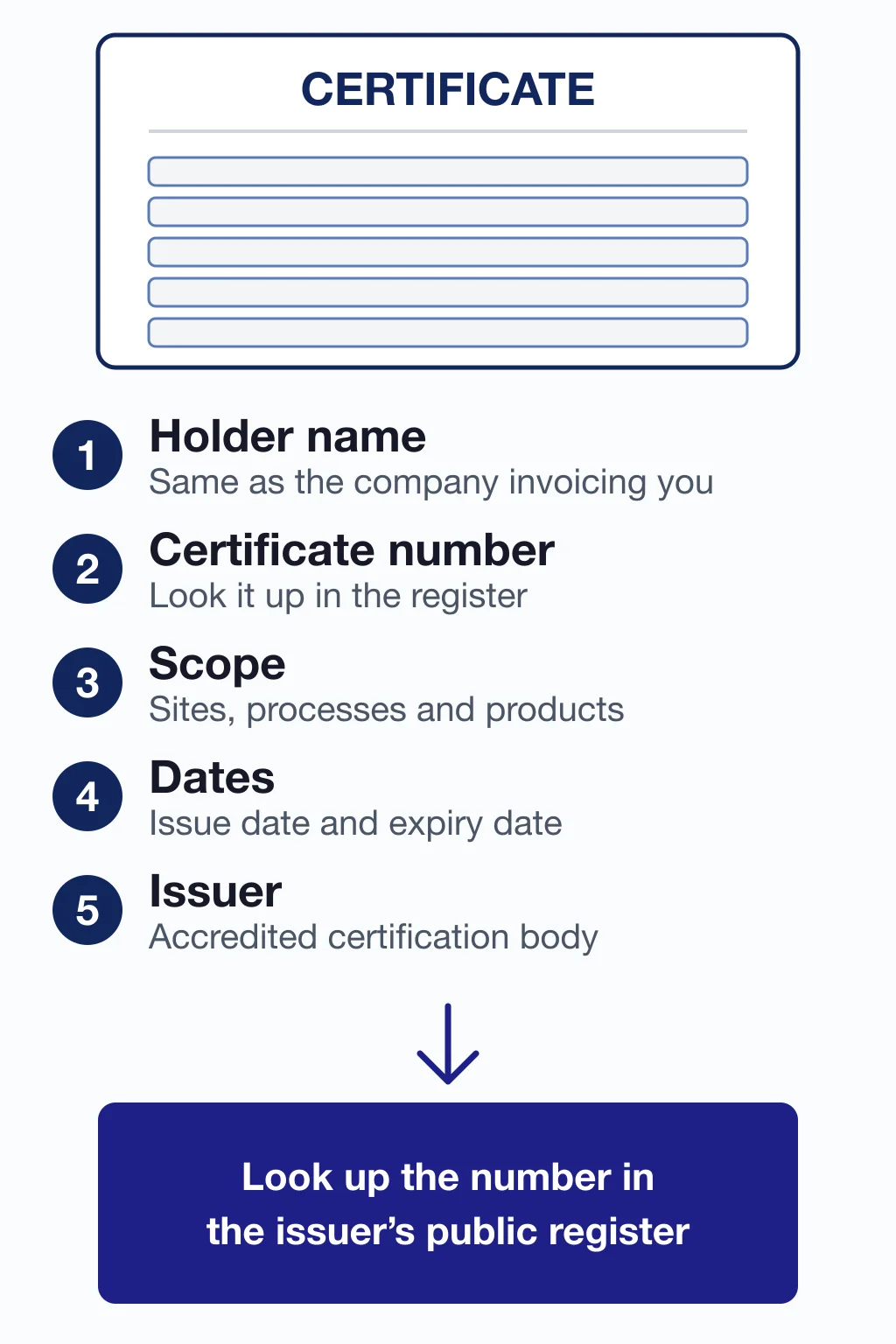
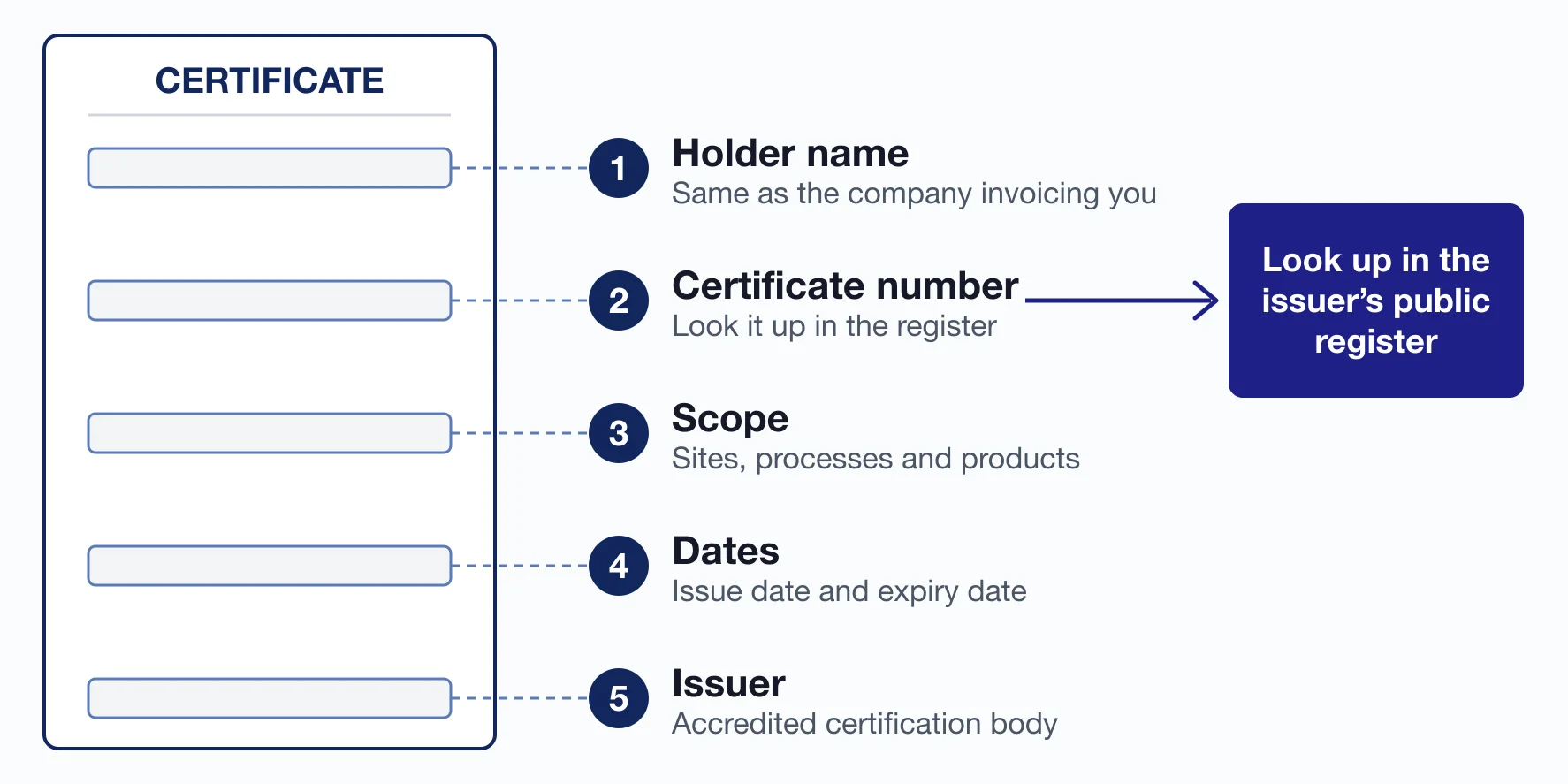
Ask for the certificate itself (a PDF or a copy), not a logo. Then check:
- Holder name: The legal name matches the company that quotes and invoices you. If it does not, read jeans manufacturer vs wholesaler.
- Certificate number: Look it up in the issuer's public register. For GRS, RCS and OCS, this is Textile Exchange's certified-organisation database. For ISO, it is the certification body's register, or the accreditation body's search where one is available.
- Scope: Which sites, processes and product categories are covered. Make sure the site that will make your jeans is listed.
- Dates: The issue date, the expiry date and, for ISO, the latest surveillance audit.
- Issuer: The certification body is named and accredited for that standard.
For amfori BSCI, ask for the audit date, the rating and the audited site. Access to results goes through the amfori platform, so not every result is public.
For GRS and RCS claims, ask for the scope certificate before you order. Ask for a transaction certificate for each shipment you intend to label.
If any check fails, or the factory cannot show the document, treat the badge as unverified.
Which certifications matter for which buyer?
Start from what your retailer or your own product claim requires. Do not start from a list of logos. These mappings are typical, so confirm them against your retailer's supplier requirements.
Retailer or marketplace supplier audits
Retailers usually ask for a social audit, such as amfori BSCI or an equivalent they accept. Many also ask for ISO 9001. Check the retailer's supplier manual for the exact list.
Recycled-content claims on labels or product pages
You need GRS or RCS throughout the chain, including the fabric mill, plus transaction certificates. See denim fabric weights explained for certified fabric choices.
Organic cotton claims
You need OCS. It follows the same chain-of-custody logic as RCS.
Environmental or sustainability reporting
ISO 14001 supports reporting on the factory's environmental system. GRS adds environmental criteria at certified sites. Neither one gives you a product-level footprint figure.
Small brands with no retailer requirement yet
Ask for the factory's certificates anyway, as evidence of a managed factory. Only pay for certified material if you will make a claim. For wider supplier checks, see how to choose a denim manufacturer.
What to request from any denim factory: a checklist
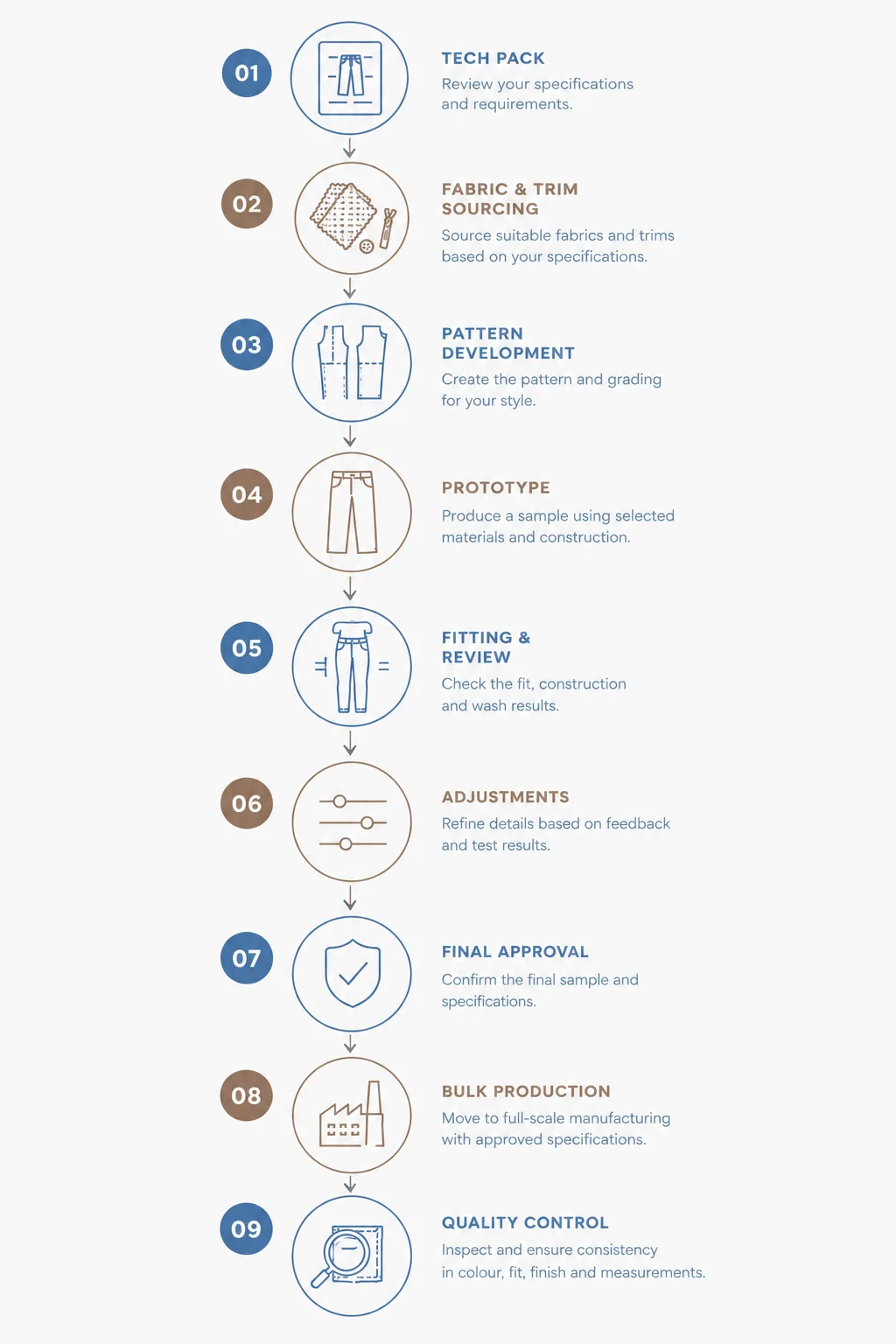
Raise certification at the enquiry and tech-pack stage. In the process below, it belongs in step 1, tech-pack review.
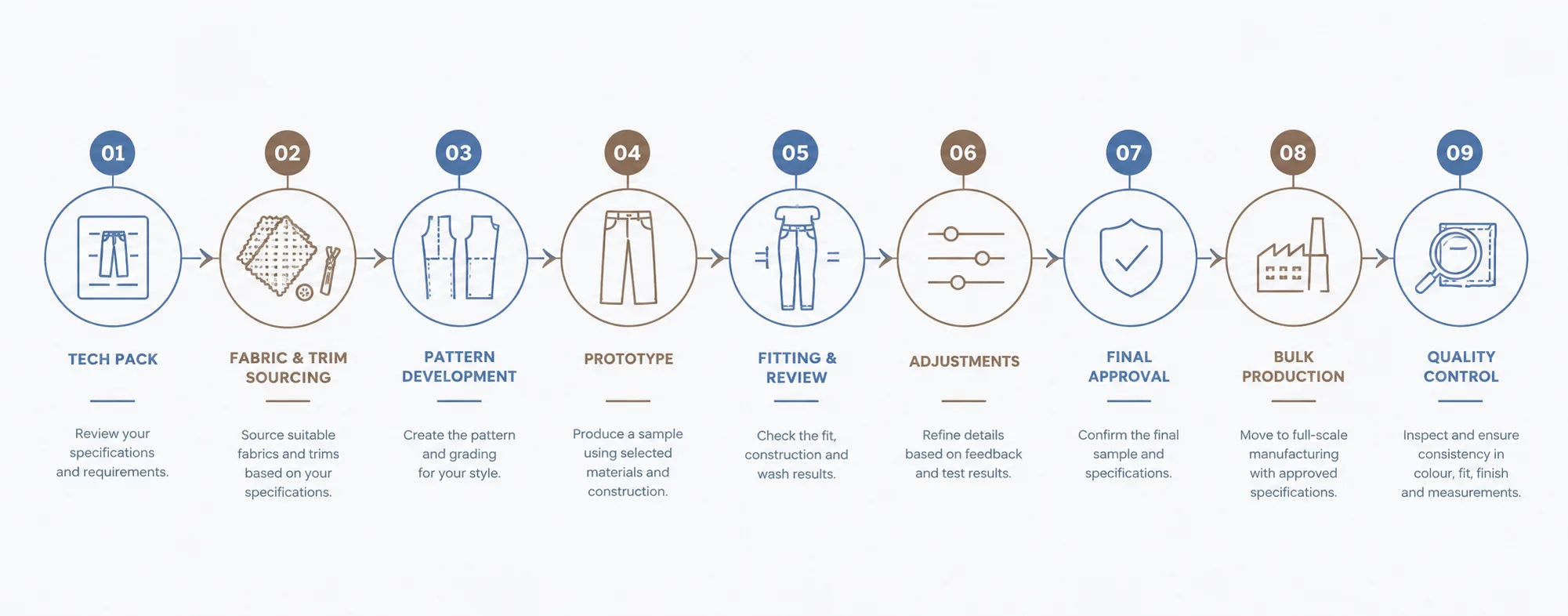
Copy this list into your enquiry:
- A copy of each certificate, with its number, scope and expiry
- The certified sites, and confirmation of which site will make your order
- The latest social audit date and rating (amfori BSCI or equivalent)
- For recycled or organic claims: certified fabric options and the mill's certificate, then a transaction certificate per shipment
- The name of the certification body, so you can check the register
- Notice of any expiry or change during your order
Certified fabric has to be sourced before the first sample, so a claim affects sampling and lead time. See denim sampling explained for how that stage works.
Add “certified content: yes/no, which standard” to your denim tech pack.
Certifications at Top Mondial
Top Mondial holds these certifications:
- ISO 9001:2015
- ISO 14001:2015
- amfori BSCI
- Global Recycled Standard
- Recycled Claim Standard 100
- Recycled Claim Standard Blended
- Organic Content Standard 100
- Organic Content Standard Blended
- ICS
You can see the badges on the factories page.
Buyers can ask us for certificate copies, scope and audit details for their project. We make everything in our own factories, one in Zhejiang, China, and two in Cambodia.
Send your product, quantity and the certifications your buyer requires.