Guide
Import duty on jeans:
how US and UK buyers estimate landed cost
Last reviewed: 25 October 2026. This is not customs advice. A licensed customs broker confirms classification and the rate on the day of entry.
With a factory quote in hand, the next numbers to sketch are the border add-ons on a first denim order into the US or the UK.
Duty is rate × customs value. Both depend on HS heading, fibre, gender and country of origin. This page states no current rates.
For where to sew, read China vs Cambodia denim manufacturing. For who pays freight and duty, read FOB, CIF and DDP. For the factory price itself, read cost to manufacture jeans.
What import duty on jeans actually is
Duty is a customs charge on the declared jeans, not a factory surcharge. The factory FOB price is only one input.
The sequence is classified heading, then customs value (FOB-based in the US; CIF in the UK), then the rate from the official tariff on the day of entry, then UK import VAT or the US merchandise processing fee and harbour maintenance fee. Those extras are named only.
Landed cost is factory price + freight + insurance + destination charges + broker + duty + import VAT or US fees + inland delivery. The factory stack is in cost to manufacture jeans. Who pays which line is in FOB, CIF and DDP.
Under DDP the seller pays duty, but it is still inside the price. Under typical new-customer FOB, the buyer or their broker pays at the border.
This page quotes no rates.
HS codes for jeans: 6203.42, 6204.62, and why fibre and gender matter
HS is a nested heading: chapter, then heading, then subheading. Importers declare a full national code. This page only names the stable jeans headings.
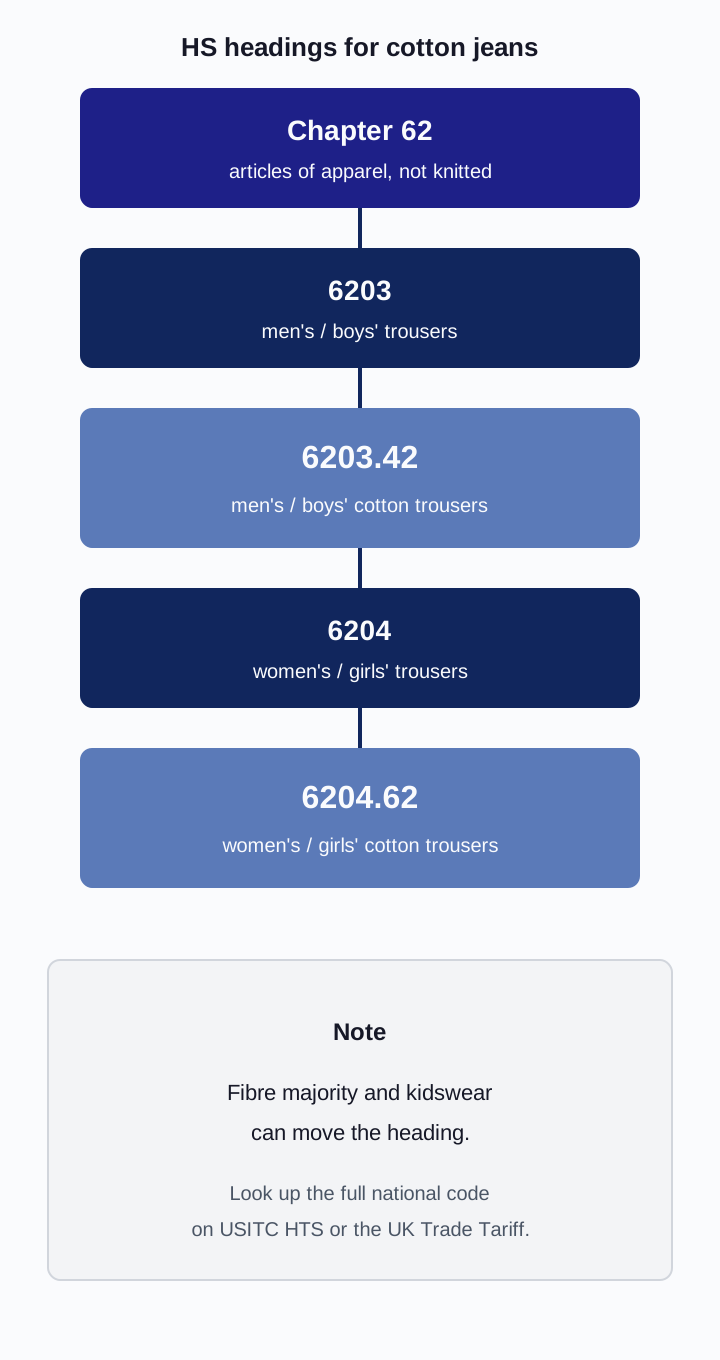
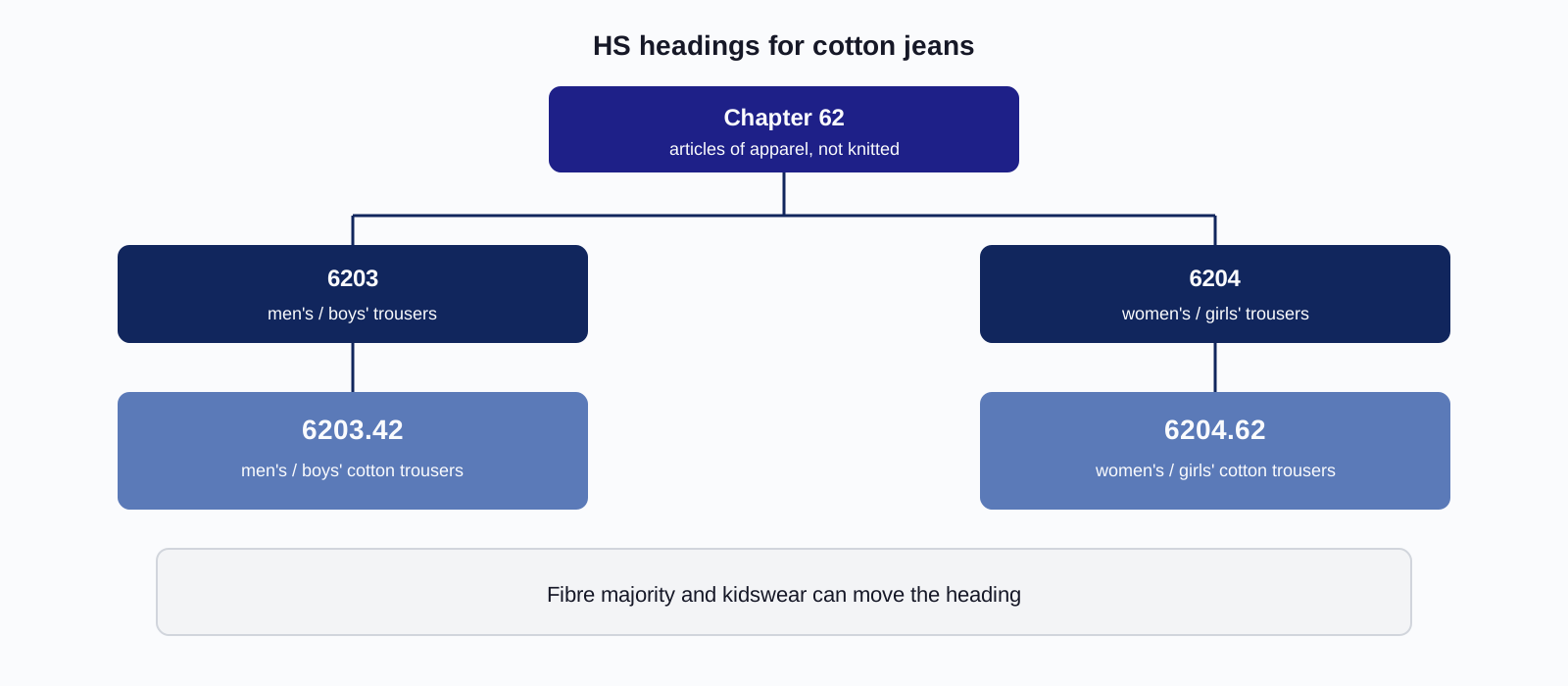
The main cotton jeans headings are 6203.42 (men's/boys' cotton trousers) and 6204.62 (women's/girls' cotton trousers).
Fibre majority matters. Cotton-majority and synthetic-majority garments can sit under different headings. Do not guess extra numbers. Look up the fibre split on USITC HTS or the UK Trade Tariff.
Gender split matters. Men's/boys' and women's/girls' are different headings even for the same fabric.
Kidswear is different again. Infants and some children's garments can sit under headings other than adult 6203.42 / 6204.62. Confirm kidswear with the broker and the official tool.
Classification is the importer's or broker's job, not the factory's marketing description. A style called "jean" that is a skirt, a short or a majority-elastane trouser may not be 6203.42 or 6204.62.
How the US and the UK value a jeans shipment for duty
The same carton is valued two different ways. These cards are methods, not rates. Who pays under FOB or DDP is in FOB, CIF and DDP.

United States
Customs value is FOB-based. In the usual case that is the price paid for the goods at export. It does not include international freight and insurance.
How duty is worked
- Duty = X% × that customs value
- Additional US tariffs on China-origin goods may stack on top of the HTS column
- Section 301 and later actions move; look them up rather than copying a figure from this page


Fees (named only)
- Merchandise processing fee (MPF)
- Harbour maintenance fee (HMF)
Official tools
- USITC HTS search for the heading and special-notes columns
- CBP for entry practice

United Kingdom
Customs value is CIF: goods plus international freight plus insurance.
How duty is worked
- Duty = Y% × CIF
- Import VAT is then charged on a VAT base that includes CIF plus duty
- The VAT percentage is taken from the official tool on the day of entry
Who pays
- Under FOB the UK buyer or their broker pays at the border
- Under DDP the seller pays. The Incoterms guide covers who pays which line
Official tools
- UK Trade Tariff on gov.uk
Country of origin: China-made vs Cambodia-made jeans
Origin follows substantial transformation where the garment is cut and sewn. It does not follow the mill that wove the denim. It does not follow the company letterhead.
Top Mondial has plants in Zhejiang, China (opened 2003) and two Cambodia plants (2022 expansion, Kandal and Takeo). Origin can be planned per order by producing in that plant. It cannot be relabelled after the fact.
China-origin and Cambodia-origin cartons must not be mixed into one origin claim.
Two named preference schemes can change the lookup. Eligibility is not decided here:
- UK: the Developing Countries Trading Scheme (DCTS) may treat Cambodia-origin goods differently from China-origin goods. Check the current DCTS list and rules of origin on gov.uk. Preferential rules can look at fabric or yarn as well as sewing. Confirm with a broker.
- US: the Generalized System of Preferences (GSP) is a named scheme whose coverage, and whether it is in force, change. This page does not say whether GSP is active, or whether Cambodia or China qualifies. Check USTR, CBP and USITC for the current position.
False origin, transshipment or "routing via Cambodia" without making the jeans there is illegal. For plant fit, read China vs Cambodia denim manufacturing. For proof of origin in general, read where denim is made. Tour the factories.
Why the duty rate on jeans changes, and why this page quotes none
Additional US tariffs on China-origin goods (Section 301 and later actions) have moved often. A copied tariff on clothing from China is a liability.
UK rates and preference margins also change when the tariff or DCTS schedule is updated.
The stable facts are the heading, the valuation method and the name of the lookup tool. The number in the tool is what matters on the entry date.
Look up the code and origin on the day you book freight and again before entry.
Where to check the current import duty on jeans
United States. Use the USITC HTS search for the heading and special-notes columns. Use CBP for entry, bond and broker practice.
United Kingdom. Use the UK Trade Tariff lookup on gov.uk.
If you are working out how to import clothing from China or Cambodia into the US or the UK, take the factory quote, fibre content, gender and origin to a licensed customs broker before the first order. Many freight forwarders offer brokerage; that split is in forwarders and customs brokers.
Official tools win over this page, the factory or a freight quote that "includes duty" without showing the code.
Worked example: estimate landed cost without quoting a rate
One shipment of cotton men's jeans, heading 6203.42, quoted FOB. Letters stand for money: FOB unit A, international freight B, insurance C, destination charges D, broker E, inland F.
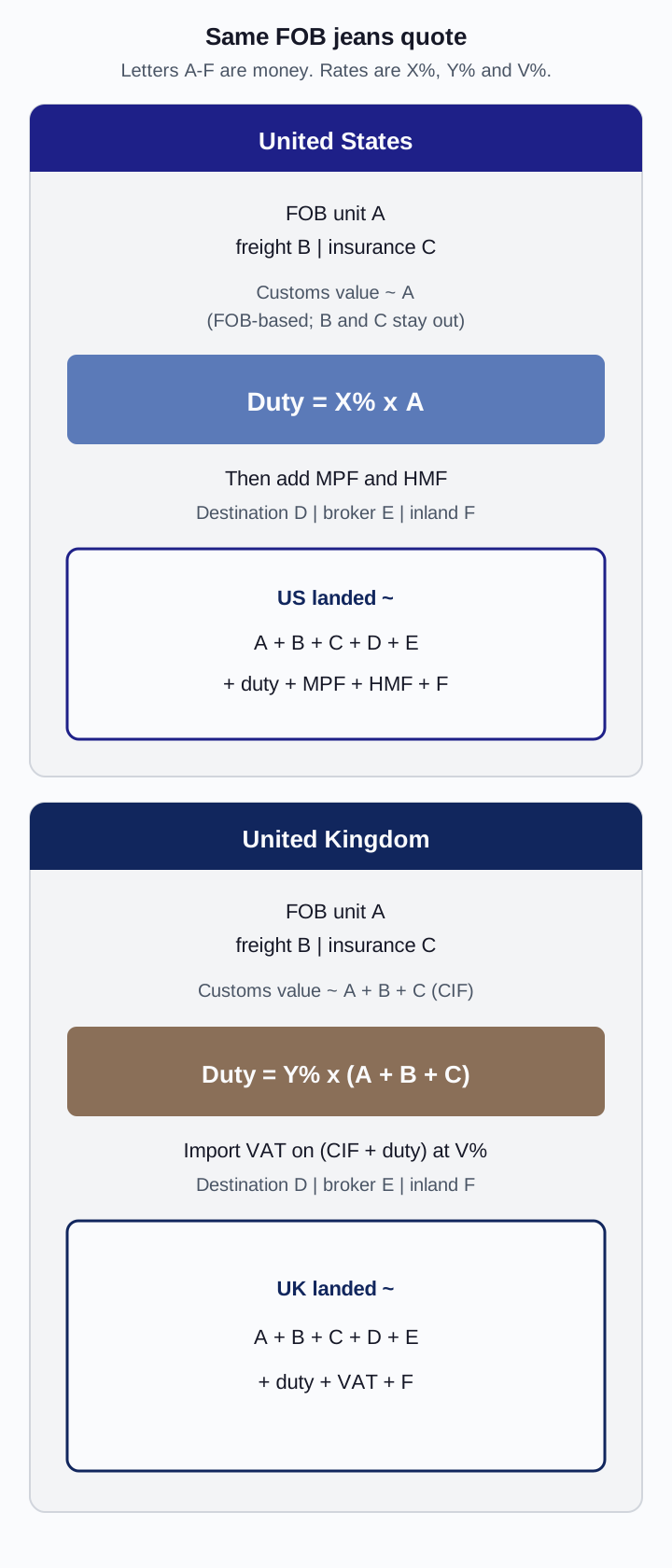
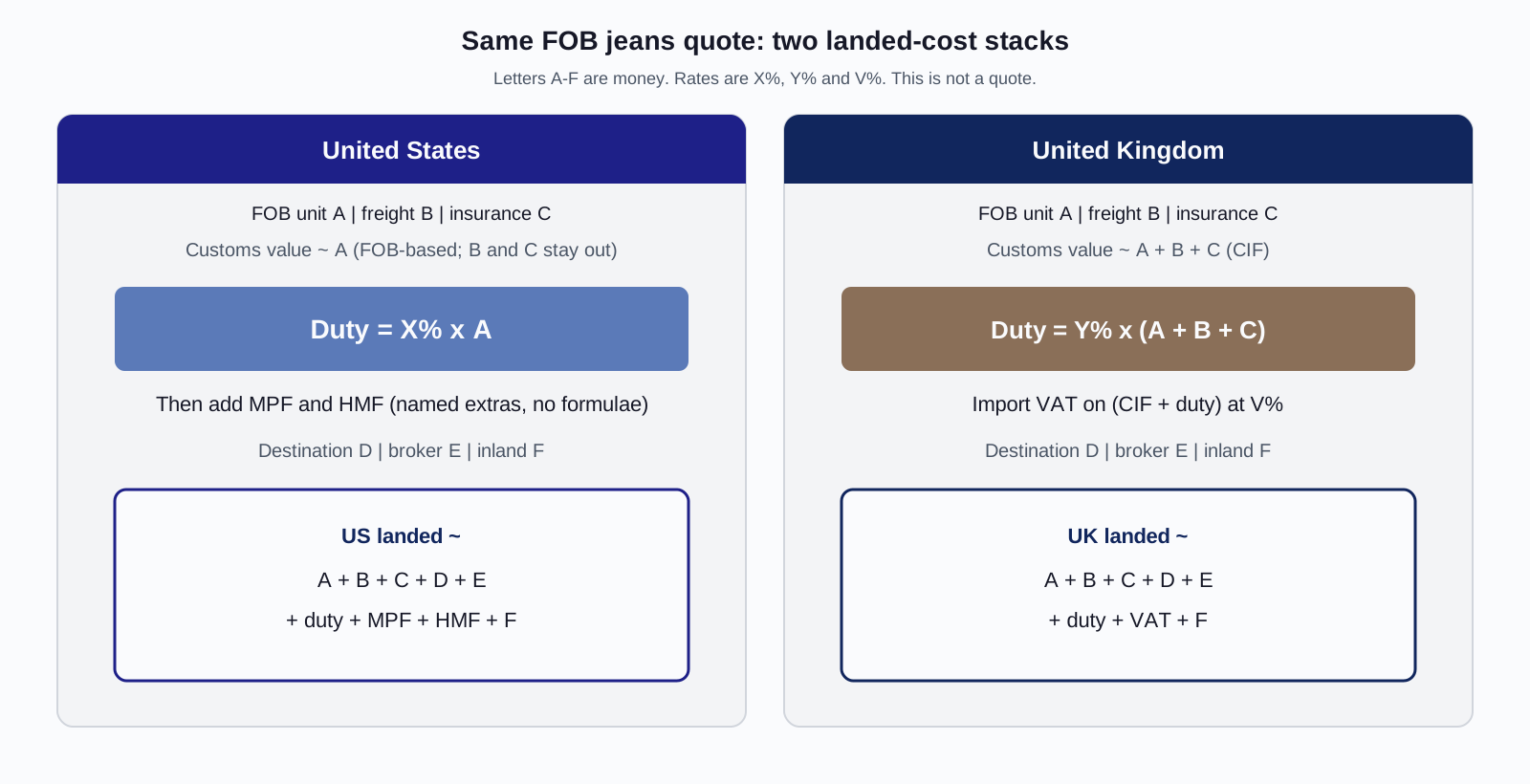
US line. Customs value is about A. Duty = X% × A. Then add MPF and HMF as named extras, with no formulae. Landed is about A + B + C + D + E + duty + MPF + HMF + F.
UK line. Customs value is about A + B + C. Duty = Y% × (A+B+C). Import VAT on (CIF + duty, plus any dutiable extras the broker includes) at V%. Landed is about A + B + C + D + E + duty + VAT + F.
Run the same letters twice if origin is China versus Cambodia. Only X% / Y% (and whether a preference code applies) change. This page does not say which origin is cheaper.
To compare an FOB quote with a DDP quote, read FOB vs CIF vs DDP. What sits inside A is in cost to manufacture jeans.
Papers the broker needs, and who supplies them under FOB vs DDP
The factory quote is not an entry pack. These four documents are the usual core.
Commercial invoice
Seller, buyer, description, quantity, unit price and currency. Incoterm and named place. Country of origin consistent with the plant that cut and sewed the jeans.
Packing list
Carton count, weights and dimensions. The packing list must match the invoice.
Certificate or statement of origin
It must match where the jeans were made. Preferential claims, such as UK DCTS, need the form that scheme requires. Confirm the current form with the broker.
Bill of lading or air waybill
The carrier document. It shows origin port against destination.
Who handles what under FOB vs DDP
Under typical new-customer FOB, the factory issues the invoice, packing list and export documents. The buyer's forwarder or broker files the import. Under DDP the seller's side files import and pays duty. Confirm who is the importer of record before the goods sail.
See FOB, CIF and DDP and payment terms explained (balance before shipment on new 30/70 T/T). UK filing basics sit in working with an overseas denim manufacturer from the UK.
Origin is set on the sewing line, not on the shipping mark
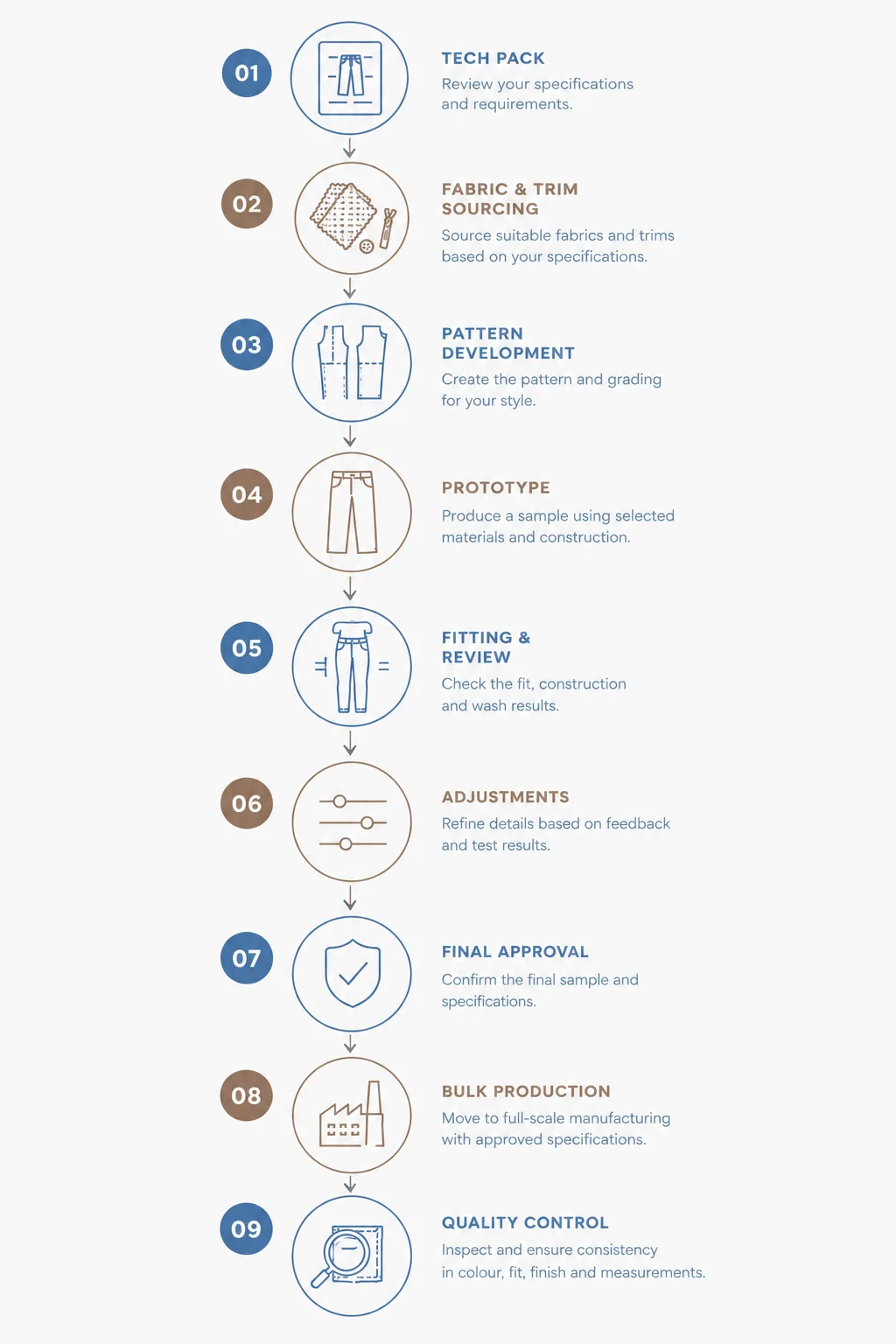
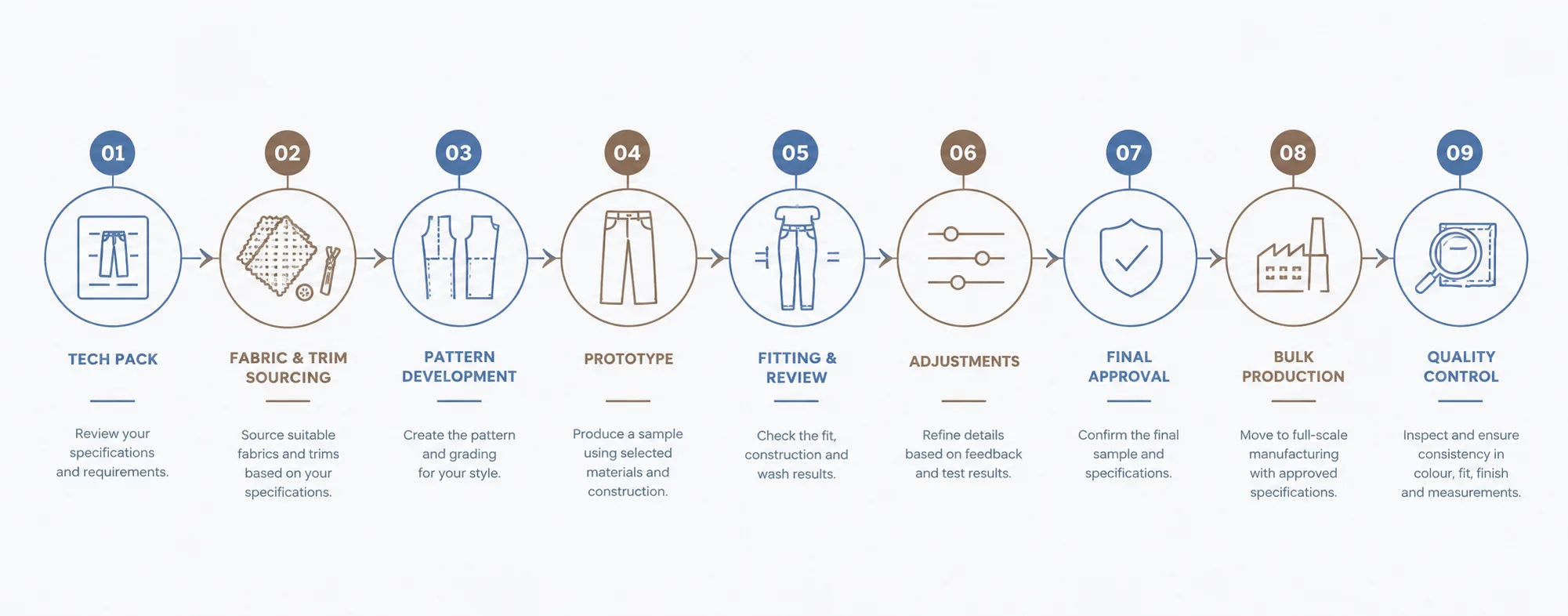
The nine-step path is the same in Zhejiang or Cambodia. The plant that cuts and sews is the origin the invoice must carry. Sampling and bulk approval happen before export. For the wash and cut sequence itself, see how jeans are made.
Planning origin and landed cost with Top Mondial
Plants in China and Cambodia mean origin can be planned per order by producing there. Tour the factories.
A typical new-customer quote is FOB, with a 30% deposit and 70% before shipment. See payment terms explained.
An in-house warehouse handles order sorting, packing and shipment preparation. We ship to 20+ markets.
When you enquire, send:
- quantity by style, colour and wash
- destination (UK or US)
- fibre and gender of the jean
- preferred origin if any
- the Incoterm the target price assumes
- a tech pack or reference garment
Partner checks sit in how to choose a denim manufacturer.