Guide
How much does it cost to make jeans?
A factory cost breakdown for brands
There is no single price for a pair of jeans. The factory price is built from fabric, trims and hardware, labels and packaging, cut-make-trim (CMT) labour, washing and finishing, plus factory overhead and margin. Fabric is usually the biggest single cost.
Spec and quantity move every part of that price. Two quotes for "the same jeans" usually differ because the spec or the quantity is not actually the same. Freight, duty and delivery then sit on top of the factory price.
This page gives no prices. It explains what moves the cost of manufacturing jeans and how to get a quote you can compare.
What goes into the cost of making a pair of jeans
The factory price of a pair of jeans has six parts.
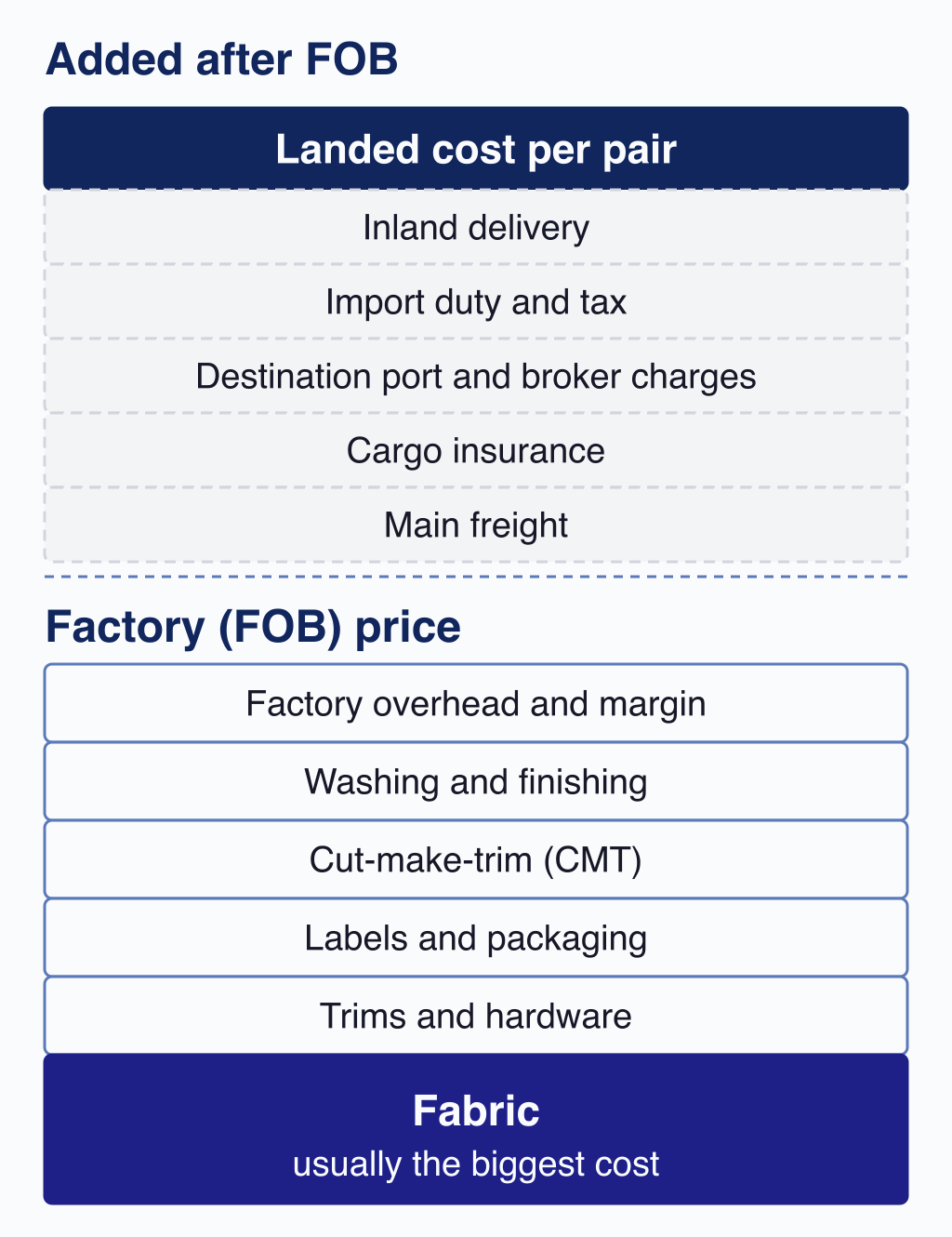
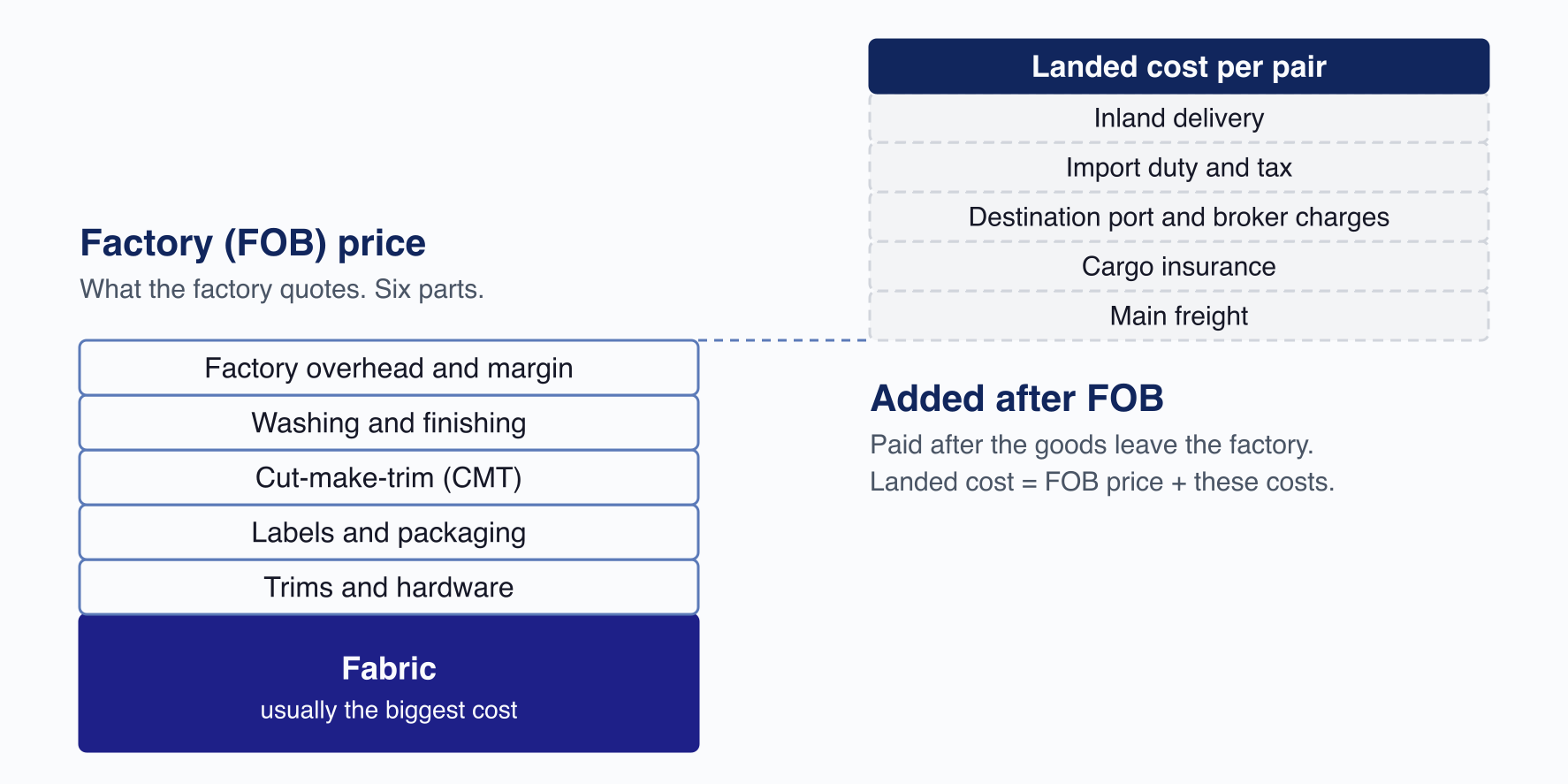
- Fabric: the denim, plus any stretch or recycled content
- Trims and hardware: rivets, buttons, zips, thread and pocket bags
- Labels and packaging: woven label, back patch, care label, hangtag, polybag and carton
- Cut-make-trim (CMT): pattern and marker, cutting, sewing and pressing
- Washing and finishing
- Factory overhead and margin
Fabric is usually the biggest single cost. Each pair uses well over a metre of denim, and the mill sets the fabric price. That is the typical pattern, not a rule for every style.
CMT depends on how many operations the style needs, such as pockets, topstitching and details. It does not depend on the fabric.
Washing depends on the steps and how much hand work goes in. A rinse is a short cycle. A heavily distressed wash adds several manual and machine steps.
Overhead and margin cover line time, quality control, export packing and admin. This is why a factory quote is more than the sum of its materials.
For the production stages behind each cost, read how jeans are made.
Which spec choices push the cost of jeans up or down
Each choice moves one part of the cost stack. The direction is what matters at briefing stage.
Fabric weight and composition
This moves the fabric cost. Heavier cloth and stretch blends change the price per metre and how the jeans behave in the wash. Mills price rigid and stretch denim differently, and which costs more depends on the mill and the construction.
For the weights and blends themselves, read denim fabric weights explained.
Organic or recycled content
This moves the fabric cost up. Certified fibre usually costs more per metre, and it may add paperwork. See sustainable denim manufacturing for how to treat these claims.
Custom or stock fabric
This moves the fabric cost and the lead time. A custom mill run carries the mill's own minimum and a development wait. Stock fabric avoids both, but you choose from what the mill already has.
The denim MOQ guide covers stock against custom fabric in detail.
Wash complexity
This moves the washing cost. From least to most work, the usual order is:
- Rinse
- Stone or enzyme wash
- Laser and ozone
- Hand sanding, whiskering and distressing
More steps and more hand work cost more. Laser and ozone can replace some manual steps, so the net effect depends on the look you want. See custom denim washes for what each finish involves.
Number of washes per style
This adds setup cost. Every extra wash has its own recipe, its own approval and its own batch. Two washes on one style cost more than one, even when the cut is the same. Denim MOQ explained shows how washes count towards the minimum.
Custom or stock hardware and trims
This moves the trims and hardware cost. Engraved rivets and buttons, custom zip pullers and branded patches add tooling and minimums. Stock trims do not. See jeans hardware, trims and branding for the options.
Embroidery or prints
This adds an operation to every pair, and possibly a separate setup. Embroidery is done in house at Top Mondial.
Worked example: the same jean at two cost levels
Take one five-pocket jean. Keep the fit and the quantity the same, and change only the spec. This page gives no prices, so the cards show which way each line of the cost stack moves. Ask a factory to quote both versions from the same tech pack to see the gap in real numbers.

Leaner spec
Suits a core style or a first order.
fabric and trims
- Stock fabric from an open line keeps the fabric cost lower
- Rigid or comfort stretch from the same open line
- Stock hardware avoids tooling
- A standard woven label


wash and making
- One rinse or light stone wash keeps the wash cost lower
- Standard five-pocket construction
- No embroidery

Premium spec
Suits a hero style or a capsule.
fabric and trims
- Custom mill fabric or certified fibre raises fabric cost
- Engraved custom hardware adds tooling
- A leather back patch raises the trims cost
wash and making
- A laser and hand-sanded vintage wash with distressing adds wash steps and hand work
- Two washes on one style adds a wash setup
- Back-pocket embroidery adds an operation
How order quantity changes the cost per pair
Some costs are fixed per style, colour or wash. These include the pattern and marker, line setup, the wash recipe and approval, and tooling for custom trims. Spread over fewer pairs, each pair carries more of them.
Fabric mill minimums add to this. Custom cloth is bought in rolls above the mill's minimum. A small order may pay for fabric it does not use, or may need to switch to stock fabric.
Wash batch size matters too. Washes run in batches, so a very small run of one wash costs more per pair.
Splitting one total across many styles and colours behaves like several small orders. Ask how the quantity breaks down per style, colour and wash.
Top Mondial's MOQ is 500 pieces. The denim MOQ guide explains how it is counted and how to reach it, for example with shared fabric, fewer washes or a core range.
Development costs to budget for before bulk
These costs come before your first bulk order. Ask how each one is charged and whether any of it is credited against bulk.
Samples
A development sample is a made-up jean that you approve before bulk. Factories usually charge for it, and the terms differ by factory. Top Mondial sampling typically takes around 7 days to develop and ship. See denim sampling explained for how the process runs.
Sample rounds
Every fit or wash change means another round. A clear tech pack cuts the number of rounds. See what a denim tech pack is for what to include.
Custom trims
Engraved hardware needs moulds or dies. Labels and patches need strike-offs for you to approve. These are one-off costs per design.
Lab testing
This covers shrinkage, colourfastness and any test a retailer requires. Who pays depends on the buyer's requirements. See denim shrinkage and stretch recovery for the tests behind the numbers.
Starting from an existing design
An ODM base style from a library of 1,000+ styles a year can need fewer development rounds than a new pattern. OEM vs ODM denim manufacturing explains the two routes, including the lower development costs of ODM.
From FOB price to landed cost: what you add on top
A factory price is usually quoted FOB. It covers production, export packing, export clearance and loading at the port of origin.
On top of FOB, you add:
- Main freight, by sea or air
- Cargo insurance
- Destination port charges
- Customs brokerage
- Import duty and import VAT or sales tax
- Inland delivery to your warehouse
Landed cost per pair is the number to set against your retail price.
With DDP, the seller arranges the journey and pays the duty. Those costs are still inside the price. Check what a DDP quote leaves out, such as unloading, storage or re-delivery.
This page gives no duty rates. The shipping terms guide points to official sources and includes a worked FOB against DDP comparison. Read FOB, CIF and DDP shipping terms for the full reference.
How to ask for jeans quotes you can compare
Quotes only compare when they price the same thing.
- Send the same tech pack to every factory.
- Give the same quantity per style, colour and wash.
- Name the same Incoterm and named place.
- Ask for the sample fee and sample-round terms in writing.
- Ask what is included: trims, labels, packaging and testing.
- Compare the currency and how long each quote is valid.
When you give a target price, say which Incoterm it assumes.
The startup manufacturer guide lists what a factory needs from you before it can quote. The denim tech pack guide covers the document that sets the spec.
When each cost lands in the order timeline
Costs arrive in a set order, and the diagram shows the production steps they fall into.
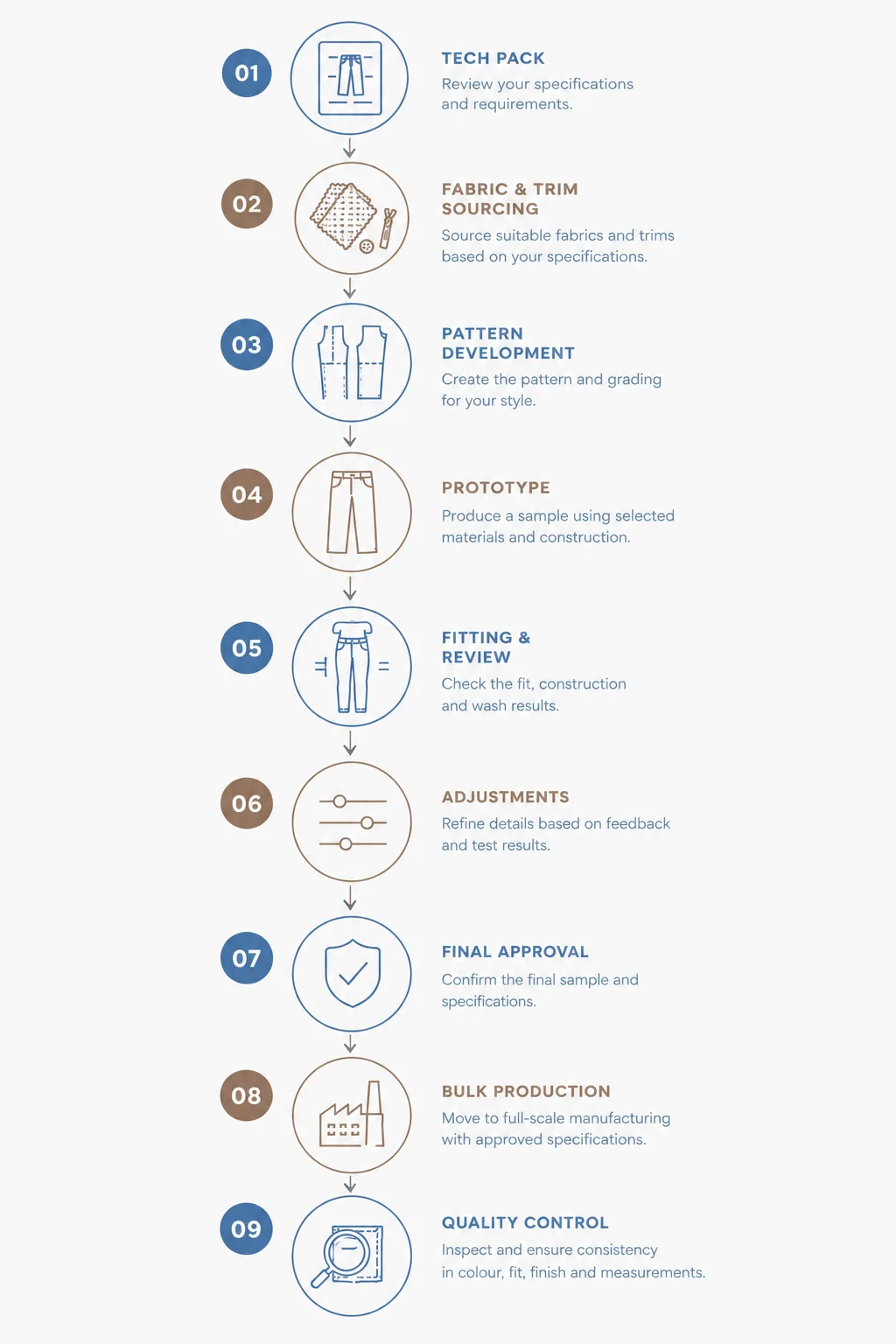
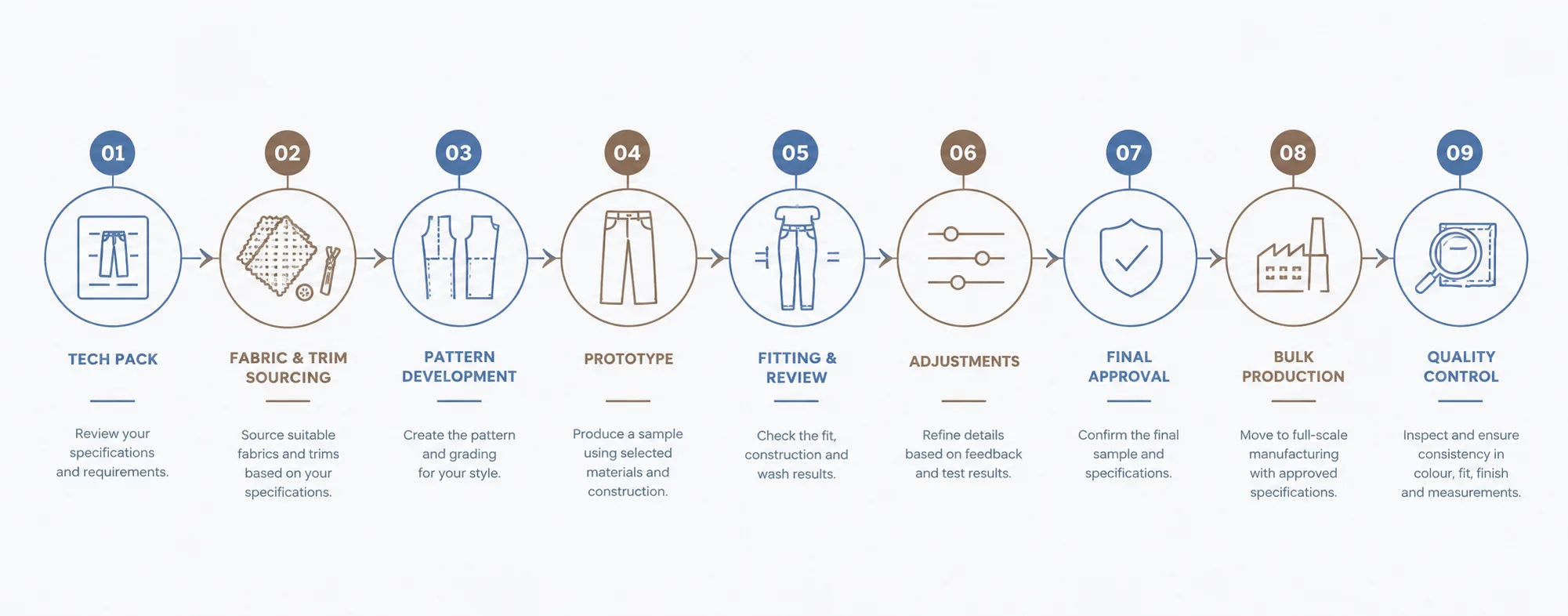
Development costs, such as samples and trim tooling, come before bulk.
The bulk deposit helps cover fabric and trims. On a new 30/70 T/T order, the balance is due before shipment. See payment terms explained for how that works.
Freight, duty and delivery are paid after the goods leave the factory, unless the order is DDP.
Bulk production typically takes around 30 days.
Costing jeans with Top Mondial
Top Mondial's MOQ is 500 pieces. Sampling typically takes around 7 days and bulk around 30 days.
We develop washes in house, so fabric and wash are approved together. Our fabric sourcing department has long-term partnerships with more than 20 fabric mills. Our ODM library adds 1,000+ styles a year.
We manufacture from one factory in Zhejiang, China, and two in Cambodia. The factories page shows the sites. Quotes for new customers are typically FOB. For what a first order involves, see jeans manufacturers for startups.
To get a quote, send us:
- A tech pack or reference garment
- Quantity by style, colour and wash
- Your target price and the Incoterm it assumes
- The destination